What is Civil Engineering? A Complete Career Guide
After Class 12, with your PCM stream completed, you stand at a crucial crossroads: which branch of engineering should you pick? You hear names like Computer Science, Mechanical, Electrical, and Chemical Engineering all around you. Amid this, you come across a term that has shaped civilizations for centuries – Civil Engineering – but what does it actually mean
Many students assume civil engineering is only about building houses or supervising construction sites. That’s barely a fraction of the picture. In reality, civil engineering designs and maintains the very framework of modern life: the roads you travel, the bridges you cross, the clean water in your tap, and the airports and metro stations you use. If you enjoy Physics and Mathematics, love solving real-world problems, and want a career where your work stands strong for decades, understanding what is civil engineering could be your first step toward a stable, impactful profession.
This guide is written specifically for Indian Class 11 and 12 PCM students preparing for JEE Main, JEE Advanced, or other engineering entrance exams. It explains the civil engineering meaning, real-world applications, subjects and skills you will need, career opportunities in India, future trends, and helps you decide if this branch is right for you.
What is Civil Engineering? A Simple and Clear Definition
Let’s begin with the core question: what is civil engineering? Civil engineering is the professional engineering discipline that deals with the design, construction, and maintenance of the physical and naturally built environment. To illustrate, this includes structures like buildings, bridges, dams, canals, highways, airports, water supply systems, and sewage treatment plants. In simpler terms, civil engineers create the backbone of modern civilization – the infrastructure that makes everyday life safe, comfortable, and efficient.
To understand civil engineering meaning better, think of it this way: When you flush a toilet, civil engineering ensures the wastewater is safely carried away and treated. When you drive on a flyover, civil engineers designed it to withstand heavy traffic and earthquakes. Even the metro rail network that helps you reach your JEE coaching class on time exists because of civil engineers.
How is Civil Engineering Different from Architecture?
Many students confuse civil engineering with architecture. In general, architecture focuses on the look, feel, and functionality of a space, while civil engineering ensures the structure stands strong and safe. An architect decides where the rooms and windows go; a civil engineer decides the size of the beams, the type of concrete, and how deep the foundation should be. At the same time, both often work closely together on the same project.
The Basic Working of a Civil Engineer
At first, a civil engineering project begins with a detailed survey of the land. Next, engineers analyze soil conditions, wind loads, seismic risks, and traffic patterns. Based on this data, they create structural designs, select appropriate materials, estimate costs, and plan construction stages. In fact, modern civil engineers use software like AutoCAD, STAAD Pro, and Building Information Modeling (BIM) tools to create highly accurate designs and simulations before a single brick is laid. The process combines scientific principles, mathematical calculations, and practical judgment – something that suits students with strong PCM fundamentals.
Real-World Applications of Civil Engineering
To illustrate the reach of this field, let’s look at some major areas where civil engineers work. You encounter these applications almost every single day, sometimes without even realizing it.
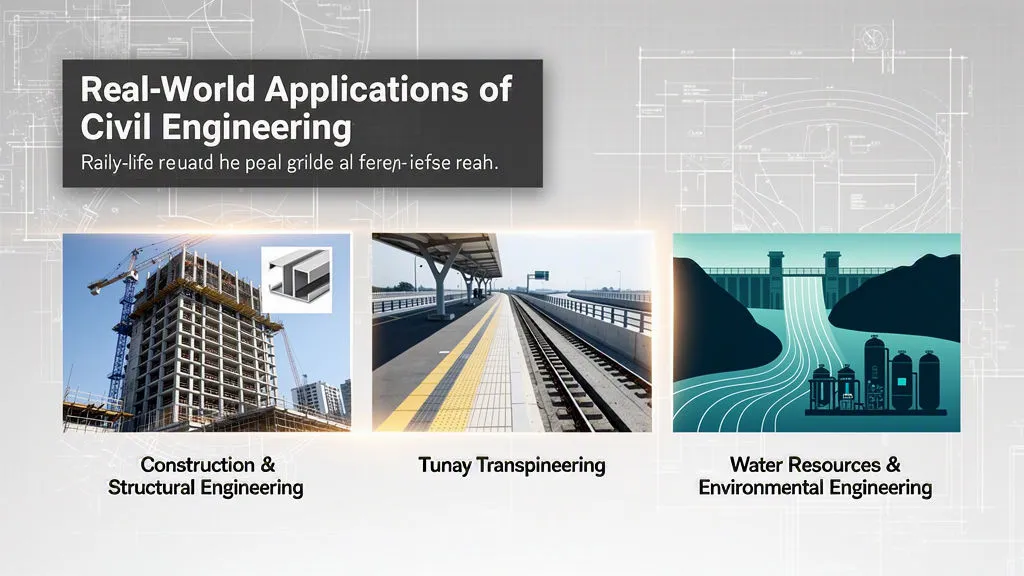
Construction and Structural Engineering
- Residential apartments, luxury villas, and skyscrapers
- Shopping malls, hospitals, and school buildings
- Stadiums, auditoriums, and industrial sheds
- Earthquake-resistant design and structural retrofitting of old buildings
Whenever you see a high-rise building under construction in your city, a civil engineer is managing the structural design, material quality, and workmanship at the site.
Transportation Engineering
- National highways, expressways, and village roads
- Railway tracks, high-speed rail corridors, and metro networks
- Airports, seaports, and bus terminals
- Traffic signal design and junction improvement
The Delhi Metro and the Mumbai Trans Harbour Link are classic examples of large-scale transportation projects handled largely by civil engineers in India.
Water Resources and Environmental Engineering
- Dams and reservoirs for irrigation and drinking water
- River interlinking projects and flood control structures
- Water treatment plants that supply clean tap water
- Sewage treatment plants and solid waste management systems
In this case, civil engineers work to ensure sustainable water management and protect communities from floods and waterborne diseases. As a result, their work directly impacts public health.
Geotechnical Engineering
- Foundation design for tall structures on weak soils
- Slope stability analysis in hilly regions
- Tunnel construction through hard rock and soft ground
- Landslide mitigation and retaining wall design
Before a single column is raised, a geotechnical engineer investigates what lies below the ground. In essence, this branch makes it possible to build safely on any terrain.
Public Health and Urban Infrastructure
- Drainage networks that prevent waterlogging during monsoons
- Solid waste collection, segregation, and scientific disposal
- Public toilets and sanitation systems under the Swachh Bharat Mission
In short, civil engineering directly contributes to the government’s flagship missions like AMRUT (Atal Mission for Rejuvenation and Urban Transformation) and the Smart Cities Mission (Ministry of Housing and Urban Affairs, 2023).
Subjects and Skills Required for Civil Engineering
To become a successful civil engineer, you need a strong foundation in Physics and Mathematics. This is why your PCM stream in Class 11 and 12 is critically important.
Essential Subject Knowledge
During your B.Tech in Civil Engineering, you will study:
- Engineering Mechanics: The behavior of bodies at rest and in motion, a direct application of Class 11 Physics.
- Strength of Materials: How different materials like steel and concrete react under various loads.
- Structural Analysis: Methods to calculate internal forces and deflections in beams and frames.
- Fluid Mechanics: The science of water flow – essential for designing pipes, canals, and dams.
- Geotechnical Engineering: Soil properties, bearing capacity, and foundation design.
- Surveying: Accurate measurement of land using instruments like total stations and GPS.
- Transportation Engineering: Pavement design, traffic studies, and highway alignment.
- Environmental Engineering: Water quality, wastewater treatment, and air pollution control.
- Construction Technology and Project Management: Modern construction methods, equipment, and planning tools.
The All India Council for Technical Education (AICTE) has prescribed a model curriculum covering all these areas to ensure graduates are industry-ready (AICTE, 2023). You can also find free video lectures on these topics on the NPTEL platform (NPTEL, n.d.), which is a great resource for students who want to explore what they will learn.
Key Skills Beyond Academics
At the same time, certain personal skills will help you thrive in this field:
- Logical and analytical thinking: You will constantly analyze data, codes, and site conditions to make decisions.
- Problem-solving attitude: Every project brings new challenges, like poor soil conditions or unexpected rain.
- Attention to detail: A small mistake in a design calculation can lead to serious safety risks.
- Teamwork and communication: Civil engineers coordinate with architects, contractors, government officials, and laborers every day.
- Visualization ability: Being able to read drawings and imagine 3D structures from 2D plans is a huge advantage.
In general, if you enjoy solving tricky physics numericals and math problems, you already have the core aptitude for a career in civil engineering.
Career in Civil Engineering: Scope in India
A career in civil engineering in India is both diverse and stable. No matter whether the economy is booming or slowing down, infrastructure needs to be built and maintained. Here are the key roles and sectors you can consider after completing your degree.
Core Job Roles
- Site Engineer: Manages day-to-day construction activities, material quality, and labor coordination on site. A typical entry-level role for fresh graduates.
- Structural Design Engineer: Works in an office environment, preparing design calculations, structural drawings, and computer models using software like STAAD Pro and ETABS.
- Quantity Surveyor / Billing Engineer: Estimates material quantities, prepares cost estimates, and handles contractor billing.
- Planning Engineer: Schedules project timelines, tracks progress, and allocates resources using tools like Primavera or MS Project.
- Quality Control Engineer: Tests materials such as cement, concrete, and steel to ensure they meet Indian Standard specifications (Bureau of Indian Standards, n.d.).
- Project Manager: After gaining 8–10 years of experience, you can lead entire projects, manage budgets, and coordinate all teams.
Employment Sectors
- Core construction companies: Larsen & Toubro, Shapoorji Pallonji, Afcons, and other major infrastructure players hire civil engineers for their projects across India and abroad.
- Government sector and PSUs: Public Sector Undertakings like Indian Railways, NHAI, CPWD, DDA, and state public works departments recruit civil engineers through GATE scores. Additionally, PSUs like ONGC, IOCL, BHEL, and NTPC have a few civil engineering positions. Government jobs offer job security and a chance to work on national-scale projects.
- Higher studies and research: A large number of graduates pursue M.Tech through GATE in specializations like Structural Engineering, Environmental Engineering, Transportation Engineering, or Water Resources. After M.Tech, you can move into advanced design, teaching, or research careers.
- Self-employment: With a valid license and experience, you can start your own construction firm, consultancy, or become a government-registered contractor.
As can be seen, the infrastructure push in India – through projects like Bharatmala, Sagarmala, and the National Infrastructure Pipeline – ensures that demand for skilled civil engineers remains high for the foreseeable future (NITI Aayog, 2021).
How to Study Civil Engineering in India
For a Class 11–12 PCM student, the roadmap to becoming a civil engineer is straightforward and based on engineering entrance examinations. There is no single “best” route; you simply need to choose the exam and institute type that fits your preparation level and circumstances.
- JEE Main for NITs, IIITs, and GFTIs: A good percentile in JEE Main opens doors to National Institutes of Technology, Indian Institutes of Information Technology offering civil engineering, and Government Funded Technical Institutes. Many state and private universities also accept JEE Main scores through their counseling processes.
- JEE Advanced for IITs: Qualifying JEE Advanced lets you join the Indian Institutes of Technology, which have long-established civil engineering departments with strong research exposure and excellent lab facilities.
- State-level entrance exams: Exams like MHT-CET (Maharashtra), WBJEE (West Bengal), KCET (Karnataka), AP EAMCET, TS EAMCET, and UPSEE admit students to reputed state government engineering colleges. These institutions often provide quality civil engineering education with lower tuition fees.
- Private universities and deemed institutions: Universities such as BITS Pilani, VIT, SRM, Manipal, and Thapar offer civil engineering programs and may conduct their own entrance tests alongside or instead of JEE scores.
- Diploma entry route: Students who complete a 3-year diploma in civil engineering after Class 10 can enter B.Tech directly in the second year through lateral entry examinations. This is an alternative path if you decide very early that this is your field.
At this point, it is important to note: no single “top college” defines your career. A civil engineer builds credibility through site experience, a strong grasp of concepts, and professional certifications over time. Where you start matters less than how consistently you learn and adapt.
Future Scope and Trends in Civil Engineering
Civil engineering is often called the “evergreen branch” because it never goes out of demand. However, the nature of the work is rapidly evolving thanks to technology and environmental priorities. Let’s look at some trends that will shape the field by the time you graduate.
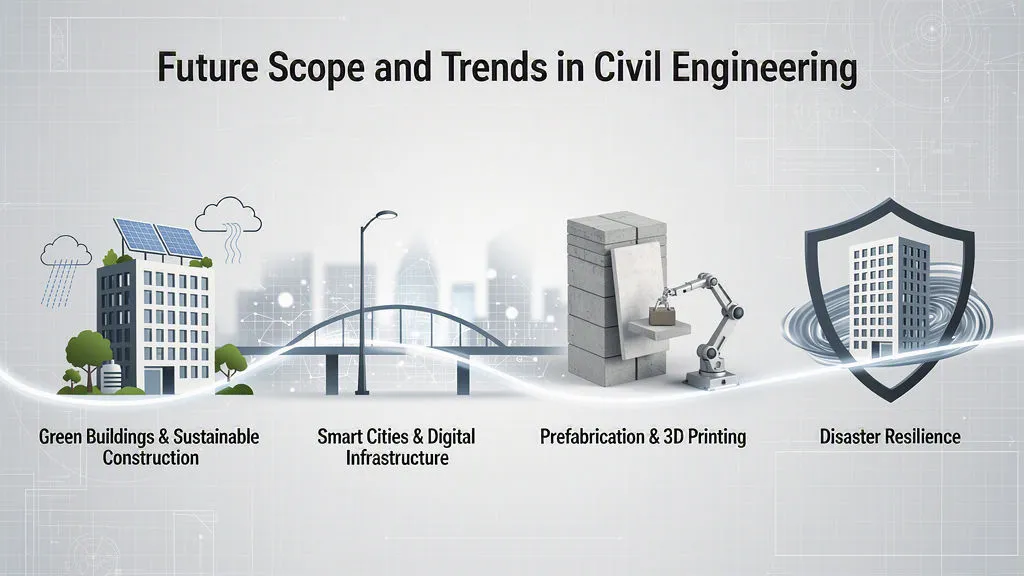
- Green Buildings and Sustainable Construction: Rating systems like GRIHA and LEED are pushing the industry to use energy-efficient designs, recycled materials, and rainwater harvesting. The Indian Green Building Council is actively promoting net-zero buildings.
- Smart Cities and Digital Infrastructure: The Smart Cities Mission has increased the use of sensors, IoT-enabled monitoring of bridges, and digital twins – virtual models of physical assets that can be tested and monitored in real time.
- Prefabrication and 3D Printing: Precast concrete elements and large-scale 3D printing are reducing construction time and waste. This means future civil engineers need to know about manufacturing and automation alongside traditional methods.
- Disaster Resilience: With climate change, India faces more cyclones, floods, and earthquakes. Civil engineers are now designing infrastructure that can withstand extreme events, often using advanced simulation software.
- Artificial Intelligence and Data Analytics: AI-based tools are entering civil engineering for traffic prediction, construction site safety monitoring, and material optimization. Basic familiarity with data handling and coding will be a bonus for your career.
- Environmental Solutions: Water scarcity, river cleaning projects, and solid waste management are national priorities. Civil engineers with a specialization in environmental engineering are at the center of these efforts (Ministry of Jal Shakti, 2023).
In summary, civil engineering in the coming decade is about smart, sustainable, and resilient infrastructure, not just concrete and steel.
Is Civil Engineering the Right Choice for You?
By now, you have a clear picture of what is civil engineering, what you will study, and where you can work. But how do you decide if this branch matches your personality and interests? Ask yourself these questions:
- Do I genuinely enjoy Physics concepts like forces, equilibrium, fluid pressure, and material properties?
- Am I comfortable with mathematics, especially calculus, trigonometry, and statistics?
- Do I like working both indoors (design/planning) and outdoors (site visits/surveys)?
- Am I okay with wearing a safety helmet and boots, sometimes in hot or dusty conditions?
- Do I find satisfaction in seeing physical results of my work – a road, a bridge, a water tank – that will serve people for years?
- Am I ready for a career where experience counts a lot and growth may be steady rather than explosive?
- Would I prefer a field where domain knowledge keeps me relevant for decades, rather than a technology that becomes outdated in two years?
If you answered “yes” to most of these questions, a career in civil engineering is likely a great match. In contrast, if you dislike outdoor work, are impatient about slow construction cycles, or prefer purely software-based innovation, you might want to explore other branches.
Frequently Asked Questions
Civil engineering designs and builds the infrastructure we use daily – roads, bridges, dams, buildings, airports, and water systems. If it is a large public structure, a civil engineer was likely involved.
No. You will learn engineering drawing, but it relies on precision and software tools, not artistic skill. Good visualization ability – imagining 3D structures from 2D plans – matters far more, and you can develop that with practice.
Physics and Mathematics are the absolute foundation. Concepts like forces, fluids, calculus, and trigonometry appear in nearly every civil engineering subject. Chemistry is helpful but not the core pillar.
Architecture focuses on a building’s look, layout, and functionality. Civil engineering ensures the structure stands strong and safe by calculating foundations, beam sizes, and earthquake resistance. Both professionals work closely together.
Civil engineering is evergreen. India’s ongoing infrastructure push – expressways, metros, smart cities, and water projects – guarantees steady demand. New areas like green buildings and disaster-resilient design are creating fresh specializations.
Yes. Civil engineering depends on analytical thinking and problem-solving, not gender. Women work successfully in design offices, labs, government roles, and on sites across India. Interest and hard work are all that matter.
Conclusion: Building Your Future Step by Step
To put it another way, civil engineering is the art and science of creating the physical world that a society needs to function and prosper. From the classroom in Class 11 where you learn Newton’s Laws, to the JEE exam hall, to a massive dam site in the Himalayas or a metro tunnel under a bustling city – the journey is long but immensely rewarding.
In conclusion, this guide has walked you through the full civil engineering meaning, its applications, the subjects and skills you will develop, the clear academic routes via JEE and state exams, the vast career scope in India, and the exciting trends that will define the profession’s future. The next step is in your hands. Use resources like NPTEL video lectures to explore a few topics, talk to working civil engineers if possible, and reflect on whether this branch aligns with your natural interests and strengths. Choose thoughtfully, and you could one day shape the skyline that a child looks up at and dreams about.
References
National Programme on Technology Enhanced Learning. (n.d.). Civil engineering courses. NPTEL. https://nptel.ac.in