What is Blockchain Engineering? Career Guide for Students

Pratik Kadam
Author
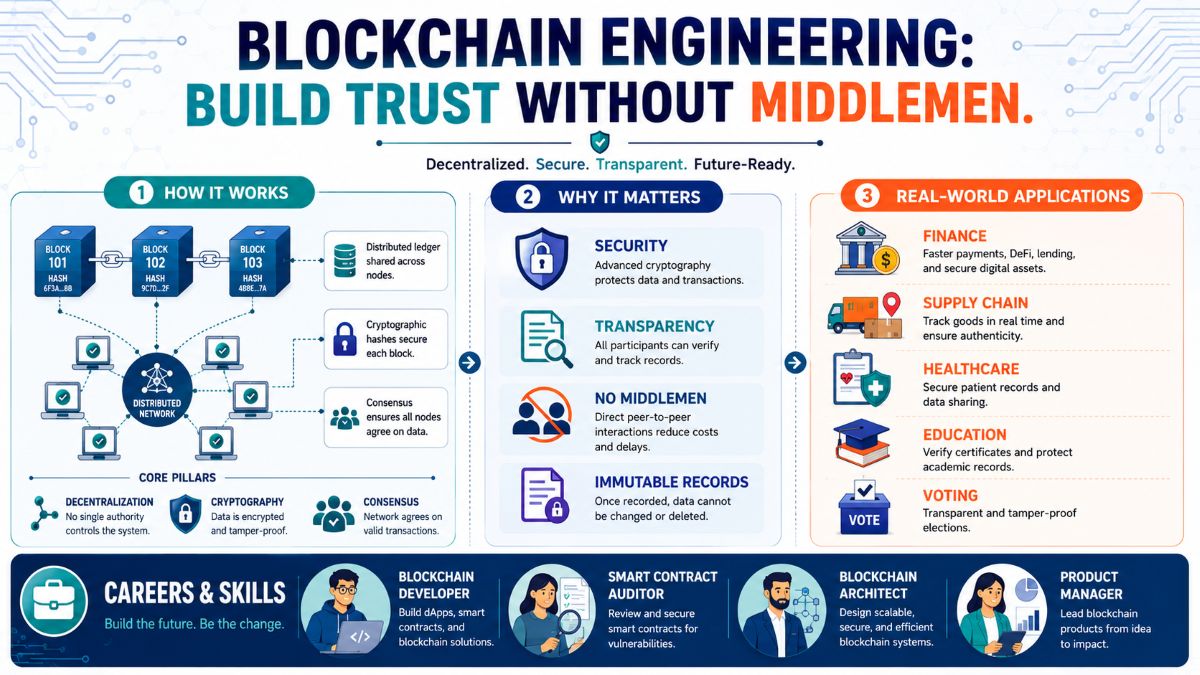
Technology is changing how we store and share data today. Systems now demand more security and transparency than before. Many students feel curious about this fast-growing field. As a result, interest is rising quickly. What is blockchain engineering and why is it important today? This discipline offers a new way to manage digital records. It removes middlemen and builds trust between users. As a result, industries adopt blockchain across many sectors. Teens today can build secure digital systems using these skills. Accordingly, learning blockchain early creates strong opportunities. This guide explains concepts, careers, and future scope clearly.
Key Takeaways
- Blockchain systems builds secure and decentralized systems
- It removes intermediaries and improves trust
- Career demand is rising across industries
- Students need coding and logical thinking skills
- Blockchain offers global innovation opportunities
What is Blockchain Engineering
Blockchain Engineering focuses on building decentralized digital systems. These systems store data across multiple computers. In other words, no single authority controls the system.
Each block stores data and connects to previous blocks. As a result, the chain remains secure and transparent. Engineers design these systems using cryptography and distributed networks. Therefore, data becomes tamper-resistant and reliable.
This field combines computer science and cybersecurity concepts. It also uses smart contracts to automate processes. For example, financial transactions run without intermediaries. Consequently, systems become faster and more efficient.
Students often begin learning through simple guides online. For instance, a beginner-friendly resource on artificial intelligence fundamentals can build logic skills. As a result, learners understand related technologies better.
Core Technologies in Blockchain Engineering
Distributed Ledger Technology
Distributed ledgers store data across many systems simultaneously. Each participant holds a copy of the ledger. As a result, transparency increases across networks.
Cryptography
Cryptography secures data using encryption techniques. It protects transactions from unauthorized access. Consequently, blockchain systems remain safe and trustworthy.
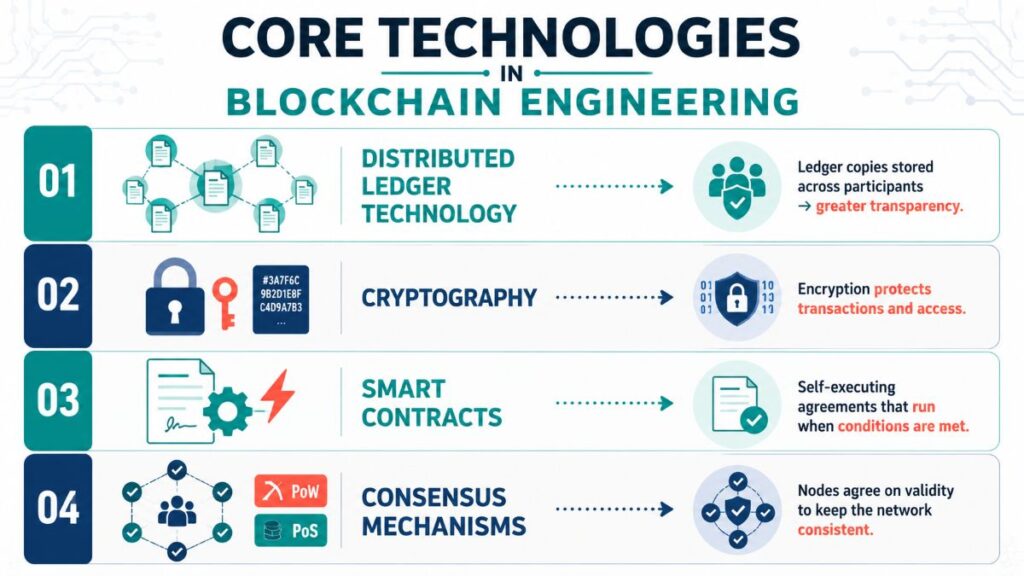
Smart Contracts
Smart contracts are self-executing agreements stored on blockchain. They run automatically when conditions are met. For example, payments trigger after task completion.
Consensus Mechanisms
Consensus ensures all nodes agree on data validity. Methods include Proof of Work and Proof of Stake. Accordingly, networks maintain consistency and security.
Why Study Blockchain Engineering
Blockchain Engineering offers strong opportunities for future-focused students. It combines innovation with practical problem solving. As a result, learners build impactful solutions.
Firstly, blockchain demand grows across industries globally. Companies need secure digital systems. Consequently, job opportunities increase steadily.
Secondly, blockchain improves transparency and trust in systems. For instance, it helps in finance and supply chains. Therefore, industries rely on blockchain solutions.
Thirdly, blockchain enables global collaboration and innovation. Students can work on international projects easily. In addition, many institutions offer blockchain courses.
Key Subjects in Blockchain Engineering
Blockchain Engineering includes several important subjects. These subjects build strong technical knowledge.
Programming
Students learn languages like Solidity, Python, and JavaScript. These languages help build blockchain applications. As a result, coding becomes essential.
Cryptography and Security
This subject focuses on encryption and secure communication. Students learn how to protect data effectively. Consequently, systems remain reliable.
Distributed Systems
Students study how systems operate across multiple nodes. This helps in understanding blockchain architecture. Accordingly, networks become scalable.
Data Structures and Algorithms
These topics improve system efficiency and performance. They help manage blockchain data effectively. Therefore, applications run smoothly.
Career Paths in Blockchain Engineering
Blockchain Engineering offers many exciting career roles. Each role focuses on innovation and system design.
Popular Career Roles
- Blockchain Developer
- Smart Contract Engineer
- Blockchain Architect
- Cryptocurrency Analyst
- Security Engineer
Each role requires coding, analysis, and logical thinking. As a result, professionals build secure digital systems.
Job Demand in Blockchain Engineering
| Industry | Blockchain Usage Example | Demand Level |
|---|---|---|
| Finance | Digital payments and banking | Very High |
| Healthcare | Secure patient records | Growing |
| Supply Chain | Product tracking systems | High |
| Gaming | Digital asset ownership | Rising |
| Government | Identity verification systems | Increasing |
This table shows blockchain demand across industries. Consequently, students have many career options.
Future Trends in Blockchain Engineering
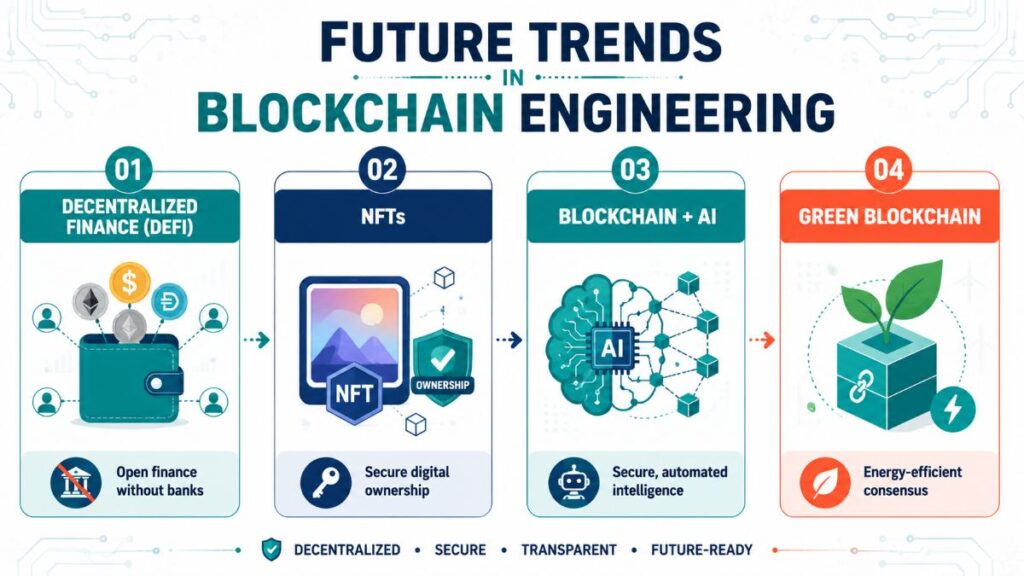
Blockchain continues evolving with new innovations. These trends shape future careers.
Decentralized Finance (DeFi)
DeFi removes banks from financial transactions. Users manage assets directly. As a result, financial systems become more open.
NFTs
NFTs represent ownership of digital assets. Artists and creators use them widely. Consequently, digital ownership becomes secure.
Blockchain and AI Integration
Blockchain combines with AI for smarter systems. It improves data security and automation. Accordingly, technology becomes more powerful.
Green Blockchain Solutions
Engineers focus on reducing energy consumption. New methods improve sustainability. Therefore, blockchain becomes eco-friendly.
Skills Needed for Blockchain Engineering
Students must develop essential skills for success. These skills combine technical and analytical thinking.
Essential Skills List
- Programming knowledge
- Understanding of cryptography
- Problem-solving ability
- Logical reasoning
- Knowledge of distributed systems
These skills help build efficient blockchain systems. Consequently, students perform better in projects.
Is Blockchain Engineering Right for You
Blockchain Engineering suits curious and analytical learners. It requires patience and continuous practice. However, rewards are significant in the long term.
If you enjoy coding and solving problems, this field fits well. In addition, interest in security systems helps learning. Consequently, students stay motivated.
Conclusion
What is blockchain engineering is no longer just a question. It is now a growing career path. This field shapes the future of digital technology. As a result, more students choose this field.
The field combines coding, security, and innovation effectively. Therefore, it prepares students for modern challenges. In summary, it is a strong career option.
FAQs about Blockchain Engineering
Blockchain engineering focuses on building secure systems that store data across networks. These systems do not need a central authority. As a result, they improve trust and transparency.
Students need programming, cryptography, and problem-solving skills. Logical thinking is also important. As a result, they can build secure applications.
Yes, blockchain engineering is a growing career with high demand. Many industries use blockchain technology. Consequently, job opportunities continue to increase.
Students study programming, data structures, and cryptography subjects. Distributed systems are also important. Therefore, strong basics help learning advanced topics.
Students can become developers, architects, or security experts. Other roles include analysts and engineers. As a result, many career paths are available.
References
Nakamoto, S. (2008). Bitcoin: A peer-to-peer electronic cash system. https://bitcoin.org/bitcoin.pdf
Casino, F., Dasaklis, T. K., & Patsakis, C. (2019). A systematic literature review of blockchain-based applications. Telematics and Informatics, 36, 55–81. https://doi.org/10.1016/j.tele.2018.11.006
Zheng, Z., Xie, S., Dai, H., Chen, X., & Wang, H. (2017). An overview of blockchain technology. IEEE International Congress on Big Data. https://doi.org/10.1109/BigDataCongress.2017.85