Computer Engineering vs Computer Science: Your Complete Guide

Pratik Kadam
Author
Introduction
Are you confused between computer engineering and computer science? You’re not alone in this dilemma. In fact, many students face this choice when applying to colleges. Both fields offer exciting career opportunities in technology. However, they focus on different aspects of computing.
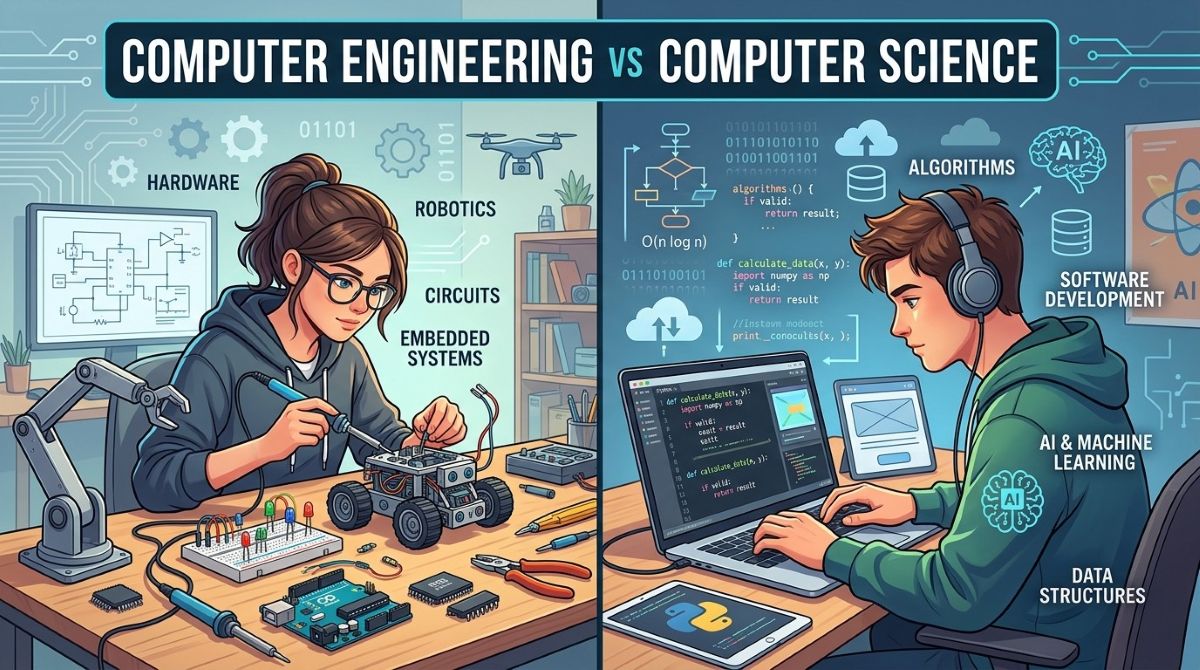
Computer science emphasizes software systems and algorithms. In contrast, computer engineering focuses on hardware-software integration. Your choice depends on your interests and career goals. For this purpose, this guide will help you make an informed decision.
Understanding Computer Science
Computer science is all about software development. Specifically, the field explores how computers process information and solve problems. Students learn programming languages and software design principles.
What You’ll Study
Computer science programs are math-heavy and theory-focused. For instance, you’ll take courses in data structures and algorithms. The curriculum includes artificial intelligence and machine learning. Additionally, database management systems form another crucial component.
Students also study computer networks and cybersecurity. Similarly, operating systems and software engineering are core subjects. The program builds strong analytical skills for problem-solving.
Who Should Choose Computer Science?
This field suits students who love coding. Moreover, you should enjoy solving puzzles using logic. Computer science appeals to those fascinated by software.
Are you interested in creating apps and websites? Do you want to work with data analysis? If so, computer science might be your ideal choice.

Understanding Computer Engineering
Computer engineering combines hardware and software knowledge. In particular, the field focuses on building physical computing systems. Engineers design devices that integrate both components seamlessly.
Curriculum Overview
Computer engineering programs include more electronics coursework than CS. For example, you’ll study microelectronics and circuit design. Calculus-based physics becomes essential in this program. In addition, digital signal processing forms a key component.
Students learn about embedded systems and microprocessor architecture. Furthermore, the program also covers firmware development and hardware interfaces. You’ll work with both circuits and code.
Ideal Candidates for Computer Engineering
This major suits students who enjoy hands-on work. At the same time, you should be curious about how devices function. Computer engineering appeals to those who like building things.
Are you fascinated by smartphones and IoT devices? Do you want to design computing hardware? In that case, consider computer engineering as your path forward.

Key Differences Between the Two Fields
When deciding between computer engineering vs computer science, understanding their core differences helps significantly.
Focus and Approach
Computer science emphasizes computing theory and software systems. Specifically, the field deals with algorithms and data processing. Students spend most time writing code and software.
On the other hand, computer engineering focuses on hardware-software integration instead. Engineers design physical computing systems and devices. They work with both circuits and programming languages.
Course Structure
Both programs share some foundational courses initially. For instance, digital logic and computer architecture appear in both. Coding labs form part of each curriculum.
However, computer engineering requires more physics courses. In contrast, electronics and circuit design become mandatory subjects. Computer science students take more theoretical computing classes.
As a result, your daily activities differ significantly. CS students spend time debugging code and algorithms. Meanwhile, CE students work with breadboards and oscilloscopes too.
Career Opportunities in Computer Science
The job market for CS graduates remains strong. Notably, software developers represent the most common career path. These professionals create applications and operating systems.
Popular Job Roles
Data scientists analyze large datasets for business insights. Similarly, information security analysts protect systems from cyber threats. Systems administrators manage IT infrastructure for organizations.
Web developers build interactive websites and applications. In addition, machine learning engineers create AI-powered solutions. Cloud architects design scalable computing infrastructure for companies.
Job Growth and Salary
The Bureau of Labor Statistics projects 5% growth. Consequently, this translates to 4,600 job openings annually. Master’s degrees can boost earnings by $12,486 yearly.
Top engineering colleges offer excellent CS programs. Their placement records show strong industry demand. As a result, graduates find opportunities across multiple tech sectors.
Career Paths in Computer Engineering
Computer engineering graduates work with physical systems primarily. For example, hardware engineers design computer components and peripherals. They test and improve computing device performance.
Common Job Titles
Embedded systems engineers develop software for specific devices. Likewise, systems architects design large-scale computing infrastructure. Firmware developers write low-level code for hardware.
IoT engineers create connected device ecosystems. In addition, robotics engineers build automated systems using integrated hardware. Network hardware engineers design routers and communication devices.
Industry Demand
Computer engineering offers a more applied approach overall. Subsequently, engineers build practical devices using their knowledge. The field combines theoretical understanding with hands-on skills.
Salaries remain competitive with computer science roles. Similarly, both fields offer excellent earning potential for graduates. Your specific role determines your compensation package.
Admission Requirements and College Selection
Most engineering colleges require physics and mathematics background. Consequently, you’ll need strong grades in 11th and 12th. Entrance exams like JEE Main become crucial for admissions.
Choosing the Right College
Research colleges with strong placement records carefully. For instance, check their industry partnerships and internship opportunities. Faculty expertise matters significantly for your learning experience.

Lab facilities determine hands-on learning quality substantially. Moreover, look for colleges with updated equipment and software. Alumni networks help with career guidance after graduation.
Making Your Decision
Consider your interests and strengths before choosing. Do you prefer working with code or circuits? In this case, your answer guides your decision effectively.
Questions to Ask Yourself
Are you more interested in software or hardware? Do abstract concepts excite you more than tangibles? Would you rather debug code or solder circuits?
Think about your long-term career aspirations carefully. In addition, research job descriptions in both fields thoroughly. Talk to professionals working in these areas.
Visit college campuses and attend open houses regularly. Furthermore, speak with current students about their experiences. This research helps clarify your preferences significantly.
Frequently Asked Questions about Computer Science vs Computer Engineering
Can I switch between computer science and computer engineering?
Yes, switching is possible during your first year. In fact, most colleges allow branch changes based on performance. Core courses overlap significantly in the beginning.
On the other hand, switching becomes harder after second year.
You’ll need to catch up on specialized courses quickly. Therefore, plan your decision carefully before choosing initially.
Which field pays better salaries?
Both fields offer competitive salaries in the market. Generally, entry-level positions pay similarly across both degrees. Your specific role matters more than your degree.
For instance, computer
science roles in software development pay well. Similarly, computer engineering positions in hardware design also compensate generously. Experience and skills determine your earning potential ultimately.
Do I need to be excellent at physics?
Computer science requires less physics overall comparatively. In fact, basic understanding helps with foundational concepts mainly. Mathematics becomes more important for CS students.
In contrast, computer
engineering demands strong physics knowledge throughout. You’ll apply physics principles in circuit design. Electronics courses rely heavily on physics concepts.
Can computer engineers work as software developers?
Absolutely, computer engineers can become software developers. They learn programming languages during their coursework.
In fact, many CE graduates pursue software careers successfully.
However, computer science graduates have deeper software training.
They study more advanced programming concepts and algorithms. Meanwhile, CE students focus equally on hardware aspects.
Which degree offers more job opportunities?
Computer science currently shows slightly more openings. Notably, software roles dominate the tech industry landscape. The field shows 5% projected growth annually.
On the other hand, computer engineering offers specialized positions in hardware.
These roles require specific technical expertise consistently. Nevertheless, both fields provide excellent career prospects overall.
Conclusion
Both computer engineering and computer science offer rewarding careers. Computer science focuses on software and theoretical computing. In contrast, computer engineering emphasizes hardware-software integration and device design.
Your choice depends on personal interests ultimately. Consider what excites you most about technology. Think about whether you prefer code or circuits.
Research colleges thoroughly before applying anywhere. For instance, compare their programs, facilities, and placement records. Make an informed decision based on facts.
Remember, both paths lead to exciting opportunities. The tech industry needs professionals from both fields. Therefore, choose the one that aligns with your passion. Your enthusiasm will drive your success forward.
References
Bureau of Labor Statistics. (2022). Computer and information technology occupations. U.S. Department of Labor. Retrieved from https://www.bls.gov/ooh/computer-and-information-technology/home.htm
Michigan Technological University. (n.d.). Computer science vs. computer engineering: What’s the difference? Retrieved from https://www.mtu.edu
University of Maryland. (n.d.). Computer science vs. computer engineering. A. James Clark School of Engineering. Retrieved from https://eng.umd.edu