What is Chemical Engineering? A Complete Career Guide
Choosing the right engineering branch can feel like standing at a crowded intersection without a map. After Class 10, you choose the science stream with Physics, Chemistry, and Mathematics (PCM) because it keeps many doors open. Now, in Class 11 or 12, you hear words like “computer science,” “mechanical,” “civil,” and “chemical engineering.” But what is chemical engineering really about? If your mind immediately jumps to test tubes and lab coats, you are not alone. Many students confuse it with pure chemistry.
This guide is written specifically for you — an Indian PCM student preparing for JEE Main, JEE Advanced, or state-level engineering entrance exams. Here, you will understand the chemical engineering meaning, how it differs from chemistry, where it is used in the real world, the subjects you must master, career pathways in India, and whether this branch fits your strengths. Let’s begin with a clear definition.
What is Chemical Engineering?
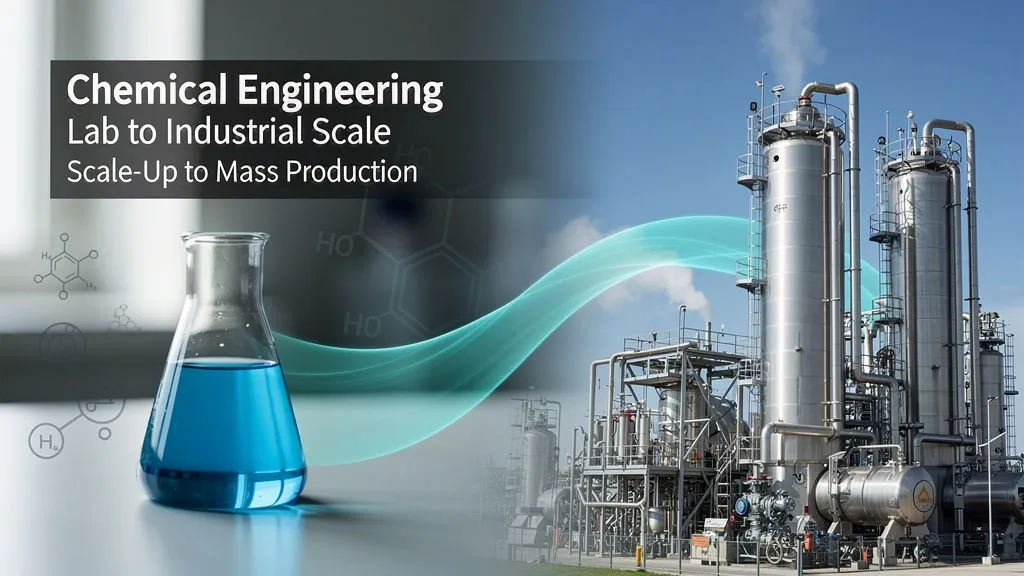
In essence, chemical engineering is the branch of engineering that transforms raw materials into valuable products on a commercial scale. For instance, the Department of Chemical Engineering at IIT Madras describes it as “the design, development and operation of processes for the production of useful materials from raw materials through chemical, physical and/or biological transformations” (IIT Madras, n.d.). To put it another way, a chemist may discover a new molecule in a laboratory beaker, but a chemical engineer designs the massive plant that makes that molecule by the ton, safely, economical ly, and sustainably.
This is the heart of the chemical engineering meaning: taking science from the lab bench to the factory floor. In essence, chemical engineers are the bridge between laboratory science and large-scale manufacturing. The field sits at the intersection of several core sciences:
- Chemistry
- Physics
- Mathematics
- Biology
Chemistry vs Chemical Engineering
It is natural to ask, “If I love chemistry, should I choose a B. Sc in Chemistry or B. Tech in Chemical Engineering?” The difference is fundamental.
- A chemist focuses on understanding matter: synthesising new compounds, analysing their structure, and studying reaction mechanisms.
- A chemical engineer focuses on processes: how to produce those compounds in bulk, controlling temperature, pressure, flow, and safety across huge equipment.
In short, chemists create recipes; chemical engineers design the kitchen, decide the size of the pans, and ensure the restaurant serves a thousand meals a day without a fire.
To illustrate, consider a simple headache pill:
- A chemist discovers the active pharmaceutical ingredient and figures out the reaction pathway.
- A chemical engineer then determines how to mix, heat, cool, crystallise, dry, and tablet that ingredient in a facility that produces millions of tablets annually with zero contamination.
Both roles are vital, but the day-to-day work looks very different.
How Chemical Engineers Think: Process and Scale-Up
At first, chemical engineering may seem abstract. In reality, it follows a logical problem-solving approach called the “process viewpoint.” Specifically, A chemical engineer breaks any production journey into a series of steps:
- Unit operations – physical changes like mixing, heating, separating, or drying.
- Unit processes – steps involving chemical reactions.
After that, These are studied and optimized one by one.
Undoubtedly, the most exciting challenge is “scale-up.” A reaction that works beautifully in a 100 ml flask can become dangerously uncontrollable in a 10,000-litre reactor. For instance, as Prof. G. K. Suraishkumar explains in the NPTEL course Introduction to Chemical Engineering, scaling up a process is not simply making the vessel larger; instead, it requires understanding how fundamental quantities like heat transfer and fluid flow change non-linearly with size (Suraishkumar, n.d.). At this point, the engineering mindset kicks in. Consequently, as a chemical engineer, you constantly ask: how do we make more, faster, safer, and with less waste?
Real-World Applications of Chemical Engineering
To truly understand what is chemical engineering, you need to see where it touches everyday life. In general, almost every manufactured product you use has a chemical engineering footprint. Here are four major industries in India that employ chemical engineers and the relatable examples that connect them to your daily routine.
Pharmaceuticals: A Career in Chemical Engineering that Saves Lives
The Indian pharmaceutical industry is among the largest in the world. Every time you take a paracetamol tablet for a fever, chemical engineering has been at work. Producing tablets involves several core chemical engineering operations:
- Reaction engineering
- Crystallisation
- Filtration
- Drying
- Coating
Quality control, sterile manufacturing, and packaging lines are designed by process engineers to meet strict regulatory standards set by bodies like the Central Drugs Standard Control Organisation. During the COVID-19 pandemic, chemical engineers helped scale up the production of vaccines and life-saving drugs under immense time pressure. In this case, the link between chemistry knowledge and engineering execution became a matter of public health.
Oil & Gas: Fuelling the Nation
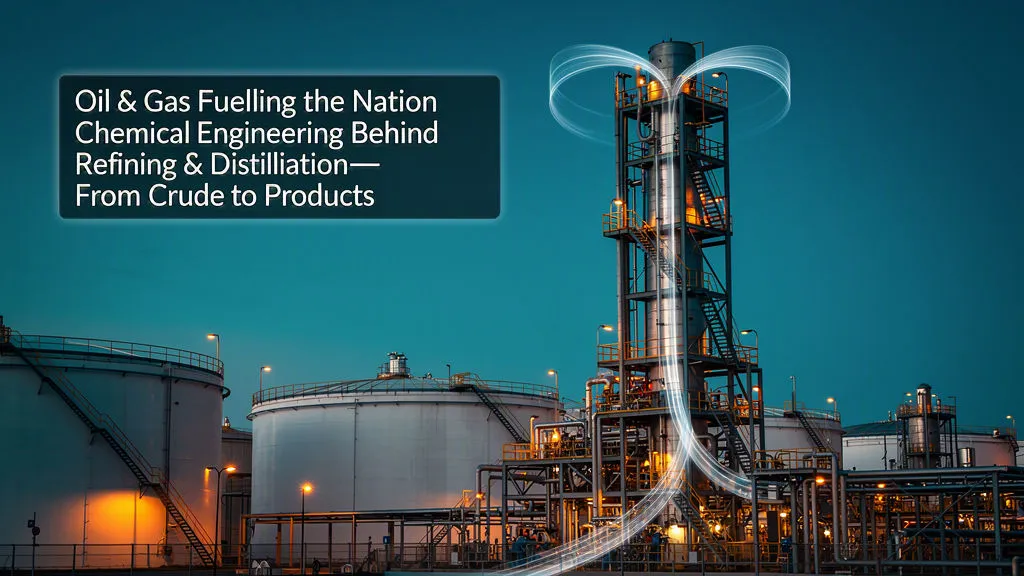
Petrol, diesel, LPG cooking gas, and even the raw material for plastics come from crude oil. As a result, the oil and gas sector relies on chemical engineers to run refineries, offshore platforms, and petrochemical plants. In a refinery, crude oil is heated in a furnace and separated into fractions inside a giant distillation column:
- Naphtha
- Kerosene
- Diesel
- Heavy residues
Designing, operating, and troubleshooting these columns requires a deep understanding of thermodynamics and fluid mechanics. Public sector undertakings (PSUs) like Indian Oil, ONGC, and GAIL recruit chemical engineers for these very roles. To explain it simply, a chemical engineer ensures that every drop of crude oil is converted into useful products with maximum efficiency and minimum environmental damage.
Food Processing: Your Favourite Snacks
Think about the instant noodles, potato chips, or chocolate bar you enjoy. Making them on a large scale so they taste the same every single time and remain fresh for months is a chemical engineering feat. Food processing involves several key technologies:
- Heat exchangers for pasteurisation
- Spray dryers for milk powder
- Extruders for pasta and snacks
- Controlled atmosphere packaging
As a result, the government’s push through the Ministry of Food Processing Industries (MoFPI) has opened many new roles. A chemical engineer in this industry might work on designing a plant that converts fresh milk into shelf-stable milk powder while preserving its nutritional value — a classic mass and energy balance problem.
Environmental Protection: Cleaning Up
In recent years, the environmental sector has emerged as a major employer. Industries need to treat their wastewater before discharge, capture harmful emissions from chimneys, and manage solid waste. Chemical engineers design the following solutions:
- Effluent treatment plants
- Catalytic converters for vehicles
- Technologies to turn waste into energy
- Air pollution control systems
With India’s growing environmental regulations, skills in pollution control and sustainable process design are in high demand. At this point, you can see that what is chemical engineering is much more than just chemistry — it is about building a cleaner, healthier world.
Subjects and Skills Required in Chemical Engineering
PCM: The Strong Foundation
Since you are already studying Physics, Chemistry, and Mathematics in Classes 11 and 12, you are building the exact foundation required for chemical engineering. Each subject contributes in a specific way:
- Chemistry – helps you understand reactions and material properties.
- Physics – gives you the laws of energy, fluid behavior, and heat transfer.
- Mathematics – becomes the language you use to model and predict process behavior (especially calculus and differential equations).
The AICTE Model Curriculum for Chemical Engineering at the undergraduate level firmly roots the first-year coursework in engineering mathematics, engineering physics, and engineering chemistry (All India Council for Technical Education [AICTE], 2018). So your current PCM effort has direct, practical value.
Core Engineering Subjects You’ll Study
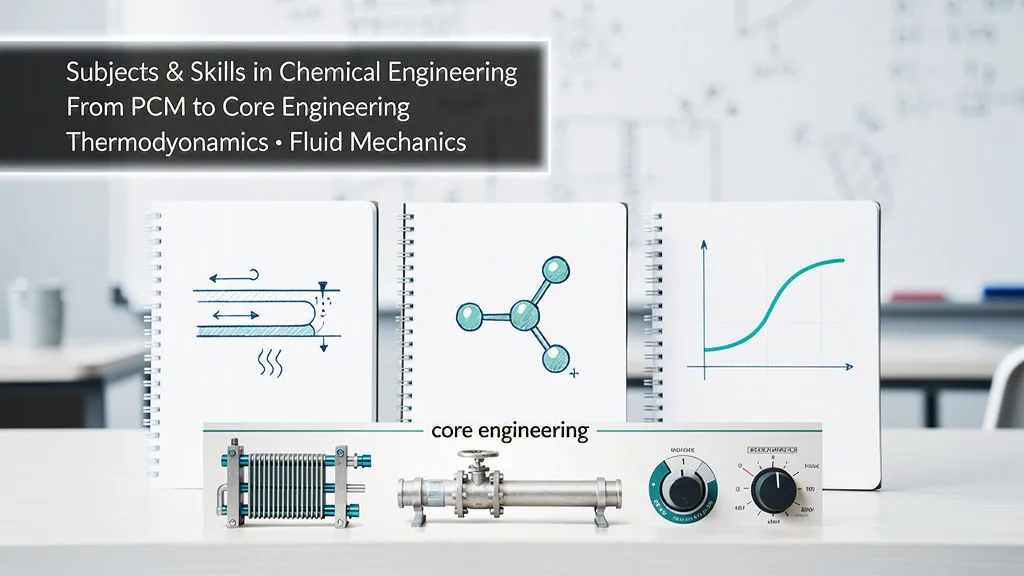
Once you enter a B. Tech program, the subjects become more specialized. Two core areas that define chemical engineering are thermodynamics and fluid mechanics.
Thermodynamics teaches you how energy converts from one form to another and how much work you can extract from a process. In detail, you learn to:
- Calculate the maximum possible yield of a reaction.
- Determine the heating or cooling required for a process.
- Decide the optimal operating pressure for a reactor.
This subject is central to designing power plants, refrigeration systems, and any process involving heat exchange.
Fluid mechanics deals with the flow of liquids and gases. Since almost every chemical process involves moving fluids through pipes, pumps, and vessels, you study:
- How pressure drop occurs in a pipeline.
- How to size pumps and control valves.
- How to handle multiphase flows (for example, gas bubbles in a liquid).
These two subjects together form the backbone of process design.
As can be seen in the AICTE model curriculum, you will also study other critical subjects (AICTE, 2018):
- Mass transfer (separation processes like distillation and absorption)
- Heat transfer
- Chemical reaction engineering
- Process control
- Process economics
All of these build on your PCM base and train you to think like an engineer.
Essential Skills for Success
Beyond subject knowledge, certain skills make a chemical engineer effective. Employers consistently rank the following abilities as critical for fresh engineering graduates:
- Logical thinking – systematically analysing a problem to find the root cause.
- Problem-solving – applying technical knowledge to real plant-floor challenges.
- Attention to detail – a minor error in a material balance can cascade into a major safety incident.
- Communication and teamwork – chemical engineers work daily with operators, chemists, safety officers, and management.
- Continuous learning – technologies and regulations change, and you must keep updating your skills.
At the same time, a responsible, safety-first attitude is non-negotiable in this field.
Career Scope in India: Where Can a Chemical Engineer Work?
A career in chemical engineering in India can take many shapes. The branch opens doors to core industries, government organizations, and research pathways. In the following section, we will explore the most common roles and sectors.
Core Industries and Process Engineering Roles
The most direct job after a B. Tech is in manufacturing. Common titles include:
- Process Engineer
- Production Engineer
- Graduate Engineer Trainee (GET)
As a process engineer, your daily responsibilities might involve:
- Monitoring plant performance and troubleshooting equipment.
- Optimizing energy and raw material consumption.
- Ensuring product quality and safety compliance.
Sectors that regularly hire chemical engineers:
- Petrochemicals
- Fertilisers
- Paints and coatings
- Cement
- Polymers and plastics
- Specialty chemicals
Indian companies such as Reliance Industries, Tata Chemicals, and Aditya Birla Group, along with several multinationals with a strong Indian presence, offer such roles. This path lets you apply thermodynamics and reaction engineering daily, often right on the shop floor.
Government Sector and Public Sector Undertakings (PSUs)
Certainly, Many Class 11 and 12 students dream of a stable government job. For chemical engineers, PSUs are a prestigious option. For example, key PSUs that recruit through the Graduate Aptitude Test in Engineering (GATE) score (Indian Institute of Technology Kanpur, 2023) include:
- Indian Oil Corporation Limited (IOCL)
- Oil and Natural Gas Corporation (ONGC)
- Gas Authority of India Limited (GAIL)
- Hindustan Petroleum Corporation Limited (HPCL)
- National Thermal Power Corporation (NTPC)
The GATE examination, conducted jointly by the IITs, tests your comprehensive understanding of engineering subjects. A high GATE chemical engineering score can land you an interview call from multiple PSUs. In addition, other prestigious organisations have their own selection processes:
- Defence Research and Development Organisation (DRDO)
- Bhabha Atomic Research Centre (BARC)
This makes a career in chemical engineering a direct route to serving the nation through public sector enterprises.
Higher Studies and Research (GATE, M.Tech, Ph.D.)
If you enjoy the academic side, chemical engineering offers deep research avenues. The pathway typically flows as follows:
- Qualify GATE with a good score.
- Secure admission to an M. Tech program at an IIT or NIT, choosing a specialisation.
- Specialisations can include process control, energy systems, environmental engineering, or biotechnology.
- From an M. Tech, you can move into R&D roles in industry or pursue a Ph.D.
- A Ph.D. opens doors to cutting-edge research in areas like nano-materials, hydrogen energy, or bioprocess engineering.
Many Indian institutes have strong sponsored research projects funded by government bodies like the Department of Science and Technology, so research is a realistic and respectable career choice.
How to Study Chemical Engineering in India
After understanding the chemical engineering meaning and career possibilities, the next logical question is: how do you get into a B. Tech program? In essence, the pathway is well-structured and aligns with the engineering entrance exams you are already preparing for.
The JEE Route: JEE Main and JEE Advanced
The most common route is through the Joint Entrance Examination (JEE). There are two levels:
- JEE Main – conducted by the National Testing Agency (NTA). It is the qualifying exam for admission to NITs, IIITs, and several Government-Funded Technical Institutes (GFTIs). The score is also used by many state governments and private universities for their counselling process (National Testing Agency, 2023).
- JEE Advanced – conducted by the IITs. You must qualify JEE Main first. Through the Joint Seat Allocation Authority (JoSAA) counselling, you can choose chemical engineering as your branch at various IITs.
These institutes offer rigorous curricula, strong laboratory infrastructure, and vibrant peer groups. A good rank in JEE Advanced can get you a seat in a chemical engineering program that is recognised worldwide.
State-Level Engineering Entrance Exams
Beyond the national-level exams, each Indian state conducts its own engineering entrance test. For example, a few prominent state exams include:
- MHT CET in Maharashtra
- WBJEE in West Bengal
- AP EAMCET in Andhra Pradesh
- TS EAMCET in Telangana
With attention to the state exam route, here are key points to remember:
- Firstly, these exams are tailored to the state board syllabus, which can align well with your Class 12 preparation.
- Additionally, qualifying can secure you a seat in a state government engineering college or a private college under the state quota.
- In Particular, programs in states like Gujarat, Maharashtra, and Tamil Nadu often have strong local industry linkages in chemical and manufacturing hubs.
- The cost of education in state colleges can be lower than in private universities.
Private Universities and Direct Admission
India has a large network of private deemed universities and independent engineering colleges that offer B. Tech in Chemical Engineering. The admission routes vary:
- Some accept JEE Main scores directly.
- Others conduct their own entrance tests.
- Some offer management quota seats.
When considering a private university, check that:
- The institute is approved by AICTE.
- The B. Tech program is accredited.
- The curriculum includes strong laboratory work and industry project opportunities.
A private university with a well-structured program can provide an excellent launchpad, especially if you make active use of internships. So, do not feel that only one exam defines your future; multiple pathways lead to the same degree.
Future Scope and Trends: Why Chemical Engineering Matters More Than Ever
As the world shifts toward cleaner and more sustainable ways of living, chemical engineers are at the front line of innovation. In summary, the branch that once gave us large-scale petroleum refining is now also building the low-carbon future.
Green Energy and Hydrogen Economy
India has launched the National Green Hydrogen Mission with the goal of making the country a global hub for green hydrogen production and export (Ministry of New and Renewable Energy, 2023). As a result, this creates several chemical engineering challenges:
- Designing efficient, durable electrolysers (essentially chemical reactors driven by electrical power).
- Developing safe, cost-effective hydrogen storage and transportation systems.
- Engineering biofuel and solar thermal processes.
- Creating recycling systems for batteries and other energy materials.
Significantly, all of these applications use the same mass and energy balance fundamentals you learn in a B. Tech program.
Sustainability and Circular Economy
India has committed to reaching net-zero carbon emissions by 2070 (Government of India, 2021). Undoubtedly, this commitment is reshaping entire industries. Chemical engineers are now developing processes for:
- Capturing carbon dioxide from industrial flue gases.
- Designing plastics that can be chemically recycled.
- Creating zero-liquid-discharge plants that recover every drop of water.
- Converting waste streams into valuable raw materials (the circular economy concept).
In short, sustainability is no longer an optional subject; it is embedded in modern chemical engineering practice.
Biotechnology and Bioengineering
At the intersection of biology and chemical engineering lies a field that is growing rapidly in India. Key application areas include:
- Vaccine production
- Enzyme manufacturing
- Bio-plastics
- Fermented food products
The core equipment is the bioreactor. The behavior of living cells in a large tank is complex, combining fluid mechanics, heat and mass transfer, and biochemistry. As India’s bio-economy expands, the demand for engineers who can design and operate bioprocess plants will rise. For students interested in both biology and engineering, this is a particularly exciting space. As a result, many Indian institutes now offer electives or even full minor programs in biotechnology alongside chemical engineering.
Is Chemical Engineering Right for You?
By now, you have a clear picture of the chemical engineering meaning and what the career demands. But how do you know if it suits you personally? Ask yourself these questions:
- Do you enjoy understanding how things are made on a large scale, not just why a reaction happens?
- Are you comfortable applying mathematics to real physical situations rather than treating it as abstract number-crunching?
- Do you get a sense of satisfaction from solving practical problems, even if the solution is not perfectly elegant but it works safely and efficiently?
- Are you interested in industries that directly touch basic human needs — energy, food, water, and health?
If your answers are mostly “yes,” chemical engineering could be a strong fit. In contrast, if you love pure theory and dislike dealing with messy real-world constraints, you might find the plant-centric nature of the field less appealing. That does not mean chemical engineers avoid theory; in fact, the theory is the foundation. But the ultimate goal is always to build something that operates reliably in the physical world.
In addition, chemical engineering requires patience and a safety-first mindset. You will often work in teams where a small oversight can have serious consequences. So, if you are detail-oriented and responsible, these traits will serve you well.
Frequently Asked Questions about Chemical Engineering
In essence, chemical engineering is the branch of engineering that transforms raw materials into valuable products on a large scale. It combines chemistry, physics, mathematics, and biology to design and operate industrial processes. To put it another way, chemical engineers take discoveries from the laboratory and make them commercially viable, ensuring safety, efficiency, and sustainability.
The difference is fundamental. A chemist focuses on understanding matter, synthesising new compounds, and studying reaction mechanisms. A chemical engineer focuses on how to produce those compounds in bulk, controlling temperature, pressure, flow, and safety across large equipment. In short, chemists create recipes; chemical engineers design the factory that makes millions of units from those recipes.
Without a doubt, a career in chemical engineering in India is strong and diverse. Graduates work in core industries like petrochemicals, pharmaceuticals, food processing, and environmental protection. In addition, public sector undertakings like IOCL, ONGC, and GAIL recruit through GATE. The growing focus on green energy, sustainability, and biotechnology further expands opportunities.
Although chemistry is part of the foundation, chemical engineering is much more than pure chemistry. The field relies heavily on physics and mathematics for process design, thermodynamics, and fluid mechanics. Consequently, if you enjoy problem-solving, logical thinking, and applying maths to real-world situations, you may still find chemical engineering a strong fit even if you do not love memorising chemical equations.
Specifically, the most common route is through JEE Main for admission to NITs, IIITs, and GFTIs, followed by JEE Advanced for the IITs. Additionally, each state conducts its own engineering entrance exams such as MHT CET, WBJEE, AP EAMCET, and TS EAMCET. Some private universities also accept JEE Main scores or conduct their own entrance tests.
First of all, you need a strong PCM foundation in Class 11 and 12. Once you enter a B. Tech program, core subjects include thermodynamics, fluid mechanics, mass transfer, heat transfer, chemical reaction engineering, process control, and process economics. Overall, these subjects train you to design, optimize, and troubleshoot large-scale industrial processes.
Conclusion
In conclusion, what is chemical engineering? It is the engineering discipline that transforms scientific discoveries into products that society uses every day — clean water, medicines, fuel, and food. Moreover, it differs from chemistry by focusing on large-scale processes, economics, and safety. For an Indian student with PCM, a career in chemical engineering offers a blend of intellectual challenge and practical impact. To sum up, the path is clear:
- Perform well in your board exams and JEE (or state entrance).
- Secure a B. Tech seat in chemical engineering.
- Build a strong foundation in thermodynamics, fluid mechanics, and process principles.
- Choose from a wide range of industries, PSUs, or higher studies.
Finally, the future of the field is firmly tied to green energy, sustainability, and biotechnology — areas that will only grow in importance. To put it another way, chemical engineers will be the architects of India’s clean industrial future.
As you prepare for your entrance exams, keep exploring the world around you through an engineering lens. The next time you drink packaged water, fill petrol in a vehicle, or take a medicine, remember that a chemical engineer made that possible. Without a doubt, that engineer could be you.
References:
Suraishkumar, G. K. (n.d.). Bioreactors. NPTEL. https://nptel.ac.in/courses/102106053